The Double Clavierist
Piano and harpsichord as media for dual realisations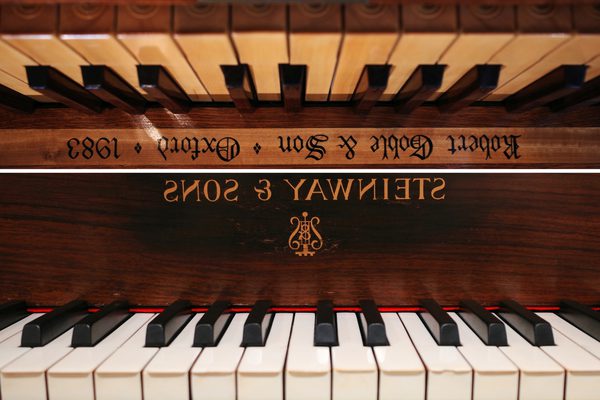
Overview
- Researcher: Xiaowen Shang
- Year research degree commenced: 2024
- Supervisors: Neil Heyde and Mei-Ting Sun
Abstract
Performing repertoire originally written for the harpsichord on the piano has long been common practice. Despite the flourishing of historically informed performance and the revival of the harpsichord, this continues today (and is perhaps even more alive than ever). Both today and in the last century pianists have demonstrated enormous enthusiasm for music that predates the instrument, incorporating it as part of their core repertoire. Harriet Cohen, Marcelle Meyer and Glenn Gould are just a few of the 20th-century figures for whom both Bach and earlier music were centrally important, and in recent years there has been a striking focus on 17th-century music as well as repertoire from the 18th century in the work of pianists like Daniel-Ben Pienaar, Víkingur Ólafsson, Anton Mejias and many others.
As a student in Beijing I was given Bach’s music to play on the piano from the age of six by my teachers, and later on Scarlatti and Handel were also included, so Baroque music was part of my ‘piano repertoire’ from the beginning. After completing high school I came to study at the Academy and encountered historically informed performance. This immediately opened a new door for me; however, I quickly realised that what drew me in was not HIP itself, but simply being able to access the music differently through playing another instrument.
Many harpsichordists have reached out beyond early music. Wanda Landowska, Elisabeth Chojnacka and Antoinette Fischer, for example, commissioned and premiered many new works and established new perspectives for the instrument, as well as drawing living composers’ attention to this ‘new’ creature of sound. Composers like Francis Poulenc, Manuel de Falla, György Ligeti and Luciano Berio were attracted by the harpsichord and composed for it. Nevertheless, there remains a striking division in how repertoire is seen to ‘belong’ to the two instruments (despite a fascinating recording that captures Landowska playing a Chopin Mazurka on the harpsichord).
C.P.E Bach claimed that ‘every keyboardist should own a good harpsichord and a good clavichord to enable him to play all things interchangeably.’ Today, it seems that the ‘interchangeability’ he advocated has been sidelined in favour of performers either focusing on a principal instrument or simply choosing the most appropriate instrument for specific pieces. My project is driven by exploring the possibilities of both instruments for the same music: separating them and treating them as equal, not aiming to build a bridge between them, which others have done.
Choosing suitable repertoire for this double perspective is critical, as everything will be recorded on both instruments. The selected pieces include Igor Stravinsky’s Piano Sonata (1924) and Robert Schumann’s Kinderszenen (both originally written for piano), Ligeti’s Passacaglia Ungherese (originally written for harpsichord) and J.S. Bach’s Well-Tempered Clavier. The project will be presented as a commercially released double-disc album with a written commentary in which I explore the processes involved. The repertoire will also include newly commissioned music by Ashkan Layegh, written from the outset with the intention that it should be played on both instruments. Another extraordinary piece for this dual perspective is Berio’s Rounds — originally written for harpsichord in 1965 and re-worked two years later for piano.
Performances, lecture recitals and presentations related to the project have included museum events in the Academy, as well as a concert in the Savonlinna Music Academy, Finland. Other planned events include a recital in the Spoleto Festival, Italy in July 2026 and coming back to give a concert for the Prix Annelie de Man 2027 in Amsterdam as a winner in the previous competition festival in 2025.
Image: Xiaowen Shang
Keyboard exuberance and invention of harpsichordist
Nothing was more delicious...
Bio
Xiaowen Shang is a pianist, harpsichordist, and versatile musician with a passion for early and contemporary music. Her repertoire spans from Renaissance composers such as Antonio de Cabezón and William Byrd to contemporary figures including Brett Dean and Roderick de Man.
Nominated as one of BBC Music Magazine’s Rising Stars 2024, Xiaowen Shang’s recent career highlights include winning First Prize of 2025 Prix Annelie de Man for contemporary harpsichord in Netherlands and coming back in 2027 as festival artist as well as the Young Artist in Association of Deal Festival 2026. In addition, her debut album with Linn Records, Music of Silence as part of the Royal Academy of Music Bicentenary Series has been featured on seven Apple Music playlists and has received positive reviews from various broadcast channels, including BBC Radio 3, Scala Radio and Radio Kraków Kultura.
She has collaborated with prominent musicians such as Steven Isserlis, Joanna MacGregor, Rachel Podger, Dame Imogen Cooper, Lawrence Power, and Adrian Brendel. As an active performer, Xiaowen has played at prestigious venues and festivals including the Royal Albert Hall, Royal Festival Hall, Wigmore Hall and the Victoria and Albert Museum.
Xiaowen leads Museum performance tours in the Academy and Fenton House in London regularly.