Enlarging the Place of the Muses
Barbara Strozzi in Viola Transcription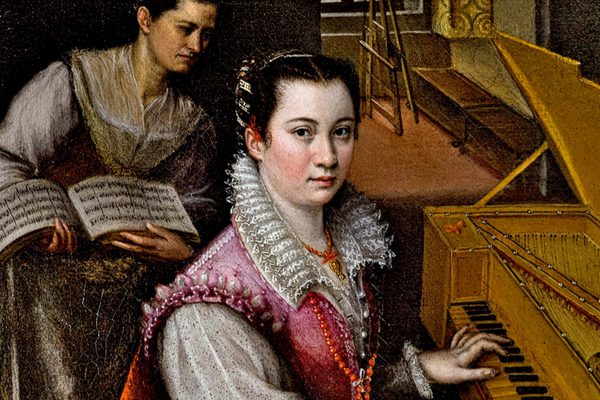
Overview
- Researcher: Madison Marshall
- Year research degree commenced: 2024
- Supervisors: Briony Cox-Williams
Abstract
In a letter published in 1655, Giovanni Francesco Loredan wrote of composer Barbara Strozzi that 'had she been born in another era she would certainly have usurped or enlarged the place of the muses.' Strozzi’s remarkable musical output stands in stark contrast to a reception history often dominated by misogynist assumptions and questions about her personal life, rather than her musical legacy. Through my doctoral project, I aim to enlarge the ‘place' of Strozzi’s music - expanding both the viola repertoire and the reach of Strozzi’s unique compositional voice.
In combining Strozzi’s historically undervalued works with the viola (a historically undervalued instrument) and transcription (a historically undervalued genre), I am operating under the theory that all three of these elements will be enriched and strengthened by the presence of each other. I am creating critical transcriptions of works by Barbara Strozzi – in bipartite editions, with one adapted for modern players, and one adapted for period-instrument players. These works are drawn from each of Strozzi’s solo cantata collections, showcasing music from both secular and sacred contexts, ranging from large-scale cantatas to shorter strophic works. Taken altogether, I believe that the resulting transcriptions will be a genuine asset to the viola repertoire; providing material for performance and pedagogy that doesn’t currently exist, and filling a hole in a repertory skewed heavily towards the twentieth century.
Image: Fontana, Lavinia. Self-Portrait at a Virginal, 1577. Oil on canvas, 27 x 23.8 cm. Rome, Accademia di San Luca
Bio
Madison Marshall enjoys a multi-faceted career as a performer, researcher, and historical performance specialist, giving concerts in venues such as Wigmore Hall, Carnegie Hall, Walt Disney Concert Hall, Lincoln Center, King's College Chapel, Cambridge, St. Martin-in-the-Fields, and the St. Thomaskirche in Leipzig.
Madison has made concerto appearances with the Utah and American West symphonies, and festival appearances at the Gstaad Menuhin Festival Academy, IMS Prussia Cove, Perlman Music Program, Dresdner Musikfestspiele, Thy Chamber Music Festival, Écoles d'Art Américanes de Fontainebleau, and Heifetz International Music Institute. She holds degrees from the Colburn School and Yale University, and is currently enrolled in the PhD program at the Royal Academy of Music as a Calleva Scholar.
An active proponent for historical performance practice, Madison received the Royal Academy of Music's Mica Comberti Prize for solo Bach performance in 2024. Fascinated by forgotten repertoire, she performed Antonio Draghi's L'humanita Redenta (not heard since its premiere in 1669) with Musica Antica Rotherhithe, and recorded an album of cantatas by seventeenth-century Danish composer Nikolai Bruhns with Masaaki Suzuki for BIS Records. She performs frequently with the Morley Consort - which specializes in sixteenth- and seventeenth-century performance practice - and with numerous ensembles in the UK and the United States.
As a chamber musician, Madison received Colburn’s inaugural Ida Levin award for excellence in chamber music, Yale’s Broadus Erle string quartet prize, and first prize at the 2023 Prix de Ravel. She currently serves as the artistic director of the Florestan Festival, a Utah-based chamber music series she founded in 2019.
Acknowledgements
This project has been supported with funds from the Calleva Foundation, the Little JAR Fund, and the Women’s Studies Group 1558-1837.