Re-embracing the effect classical music has on our bodies: Music in the Flesh at the Academy
News Story
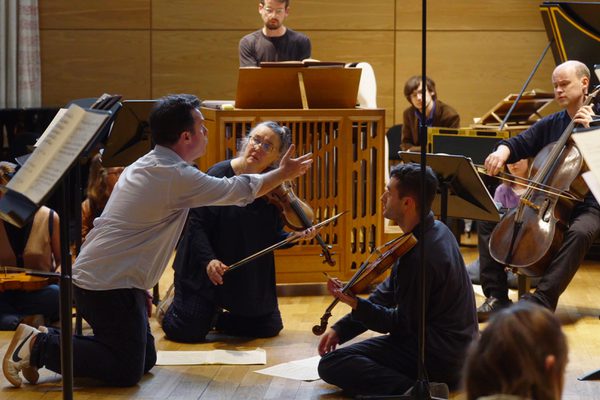
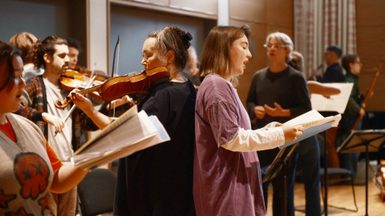
In June 2025, professional and student performers met for two days at the Royal Academy of Music to immerse themselves in a new approach to performing and listening to Bach’s St John Passion. This was part of an ambitious research project, Music in the Flesh, which now includes a newly released film of the work.
The project grew out of research by professor Bettina Varwig from Cambridge University, published in 2023, which has grown to explore the synergies between historical research and live performance. Through collaboration with Margaret Faultless, Becket Chair of Historical Performance at the Royal Academy of Music and a leader of the Orchestra of the Age of Enlightenment; and tenor Nicholas Mulroy, professor at the Royal Academy of Music and Associate Director of the Dunedin Consort, they have developed this project, using Bettina’s findings about early modern musical experiences to guide experimental workshop performances in London and Cambridge.
© Music in the Flesh
When you read about how music affected listeners in Bach’s time, their testimonies are striking in their bodily intensity. Music contracted their innards and made their hearts leap. It could taste like vinegar in your throat. It could melt your earwax. It could draw your soul out of your body.
Workshops at the Academy explored how we can re-embrace music’s powerful relationship with our bodies. Previous findings have proven how listeners’ responses to hearing music have changed vastly since the 17th and 18th century. Audiences now are more passive compared to when this piece premiered.
As a performer, we’re aware that our whole bodies are involved in making music and in hearing it. Seeing historical evidence from the time of Bach’s music, that people experienced it with much more porousness, led us to this two- day workshop at the Academy. We were very non-prescriptive in how we experienced this music and the results were contagious.
The workshops were an invitation for musicians to experiment freely with gesture, movement and communication. Using Bettina’s research and historical writings into how Bach’s musicians and congregation experienced their own bodies, along with striking images from the period, this became inspiration for trying out different ways of being in our bodies musically. The participants were encouraged to think deeply and collectively about how this music affects us and why it matters.
Players are often constrained by traditions inherited from the nineteenth century; from the acoustics of modern concert halls to conductors, to changing aesthetic tastes. But Bach really understood how to write for instruments, including all their quirks and imperfections, and it’s so liberating to embrace that!
A new film, released in June, reveals the dramatic impact that experimental performances have. You can watch the full documentary film on YouTube. You can also read more about the project in the Guardian.
The project continues at the Academy on Wednesday 1 July with a workshop on Bach’s St Matthew Passion, where participants will further develop themes explored last year.
The Academy is a community of collaborators. We encourage creative interaction between students and staff, between performers, composers, instrument makers, scholars and practitioners in other art forms, and between the Academy and the wider world. We develop and support projects that strike new ground in musical practices, engage with new audiences and have an impact in the wider world. To find out more about studying research at the Academy, visit the page below.
