Celebrating Musica Britannica at 75: Perspectives on The Mulliner Book
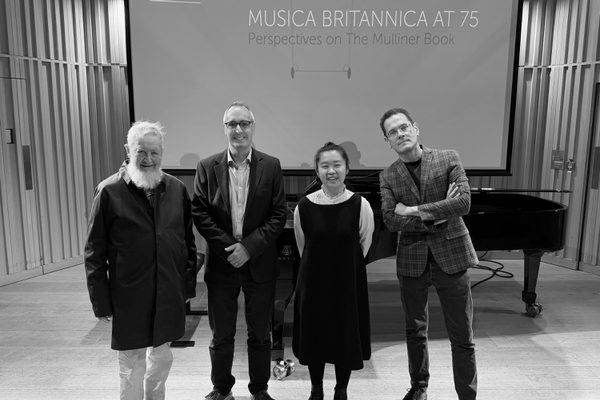
From Left to Right: Professor John Caldwell, Professor David Gorton, Xiaowen Shang, and Professor Daniel-Ben Pienaar.
© 2026 Eric Davis
News Story
PhD students Eric Davis and Bruce Ao Fang reflect on an event of 31 October 2026.
The Academy welcomed John Caldwell – editor of The Mulliner Book – joined by Daniel-Ben Pienaar and David Gorton, with a live performance by PhD student Xiaowen Shang, to offer their different perspectives as editor, performer and composer.
The evening began with a retrospective given by John Caldwell, editor of the latest edition of The Mulliner Book, a sixteenth-century commonplace book of English keyboard music complied by Thomas Mulliner. Caldwell spoke on the joys and challenges of engaging with the manuscript in the modern era, and the specific additions in his edition, which include faithful reproductions of Mulliner’s organ transcriptions, in addition to plainsong transcriptions and works for cittern and gittern.
Caldwell cited an interesting issue in the pursuit of authenticity in transcription, not only in navigating edits made by previous owners of the text, but also in interpreting more minute editorial markings. This issue becomes especially apparent when working with ornamentation, a topic which Academy pianist and professor Daniel-Ben Pienaar explored in depth during his engagements with the music of The Mulliner Book and other keyboard music of the period.
Daniel-Ben, who has commercially recorded an extensive amount of early English keyboard works, discussed his various 'editorial' decisions made during the process. Presenting excerpts of his album on The Mulliner Book, he illustrated the editorial approaches as a performer, particularly in interpretation of strokes and double strokes through note stems as ornamentations. In instances where these strokes appear inconsistently, Daniel-Ben demonstrated through various recordings how a performer's ‘intervention’ on the original text might add depth and coherence to the original score. Concluding with his recording of William Byrd’s The Carman's Whistle, Daniel-Ben summarised his aim as a performer ‘to posit an expressive practice, elaborated around problematising certain elements of craft, as a way of starting a musical dialogue with other pianists who would play this music – and listeners who love it’.
Professor David Gorton then spoke to the issues of interpretation, transcription, and transformation through engagement with The Mulliner Book, which resulted in The Mulliner Book Paraphrases, a cycle for solo piano. Each movement of David's Paraphrases takes a movement from The Mulliner Book as its starting point and elaborates. In this project, David established two interconnected compositional aims: to ‘develop a citational and critical commentary on music from the past’, and to ‘develop an aesthetic of the uncanny’, in reference to Masahiro Mori’s concept of the ‘uncanny valley’. Pianist and current PhD student Xiaowen Shang exemplified this with a performance of movements I, III, and IX from Gorton’s Paraphrases. Gorton explained in his approach that ‘compositional interventions are made to historical source materials to the extent that they become something else’. The effect of these interventions were clearly heard through Xiaowen’s performance, resulting in a carefully curated air of strangeness, ambiguity and activity across each piece through the juxtaposition of the old and the new, providing a fitting end to an evening of appreciation for the depth of material found within The Mulliner Book.
See also:
Research Catalogue: Some Discourse of Musique by David Gorton
Sheet Music for David Gorton’s Mulliner Book Paraphrases
Daniel-Ben Pienaar Discography on AllMusic
Daniel-Ben Pienaar, Album: Byrd: Pavans & Galliards; Variations & Grounds