Historical Violin Playing
Il Scolaro by Gasparo Zannetti: insight into historical violin playing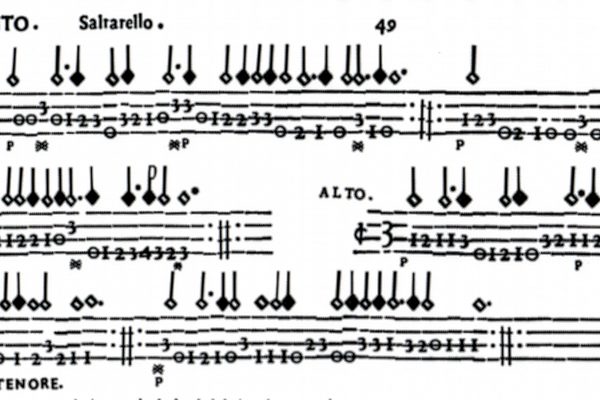
Overview
Researcher: Sophia Mücke
Milano, 1645: Carlo Camagno publishes Il Scolaro di Gasparo Zannetti per Imparar a Suonare di Violino, et Altri Stromenti. With the help of tablature, anyone should be able to easily learn to play the violin. But how does a violin tablature work? What information does it convey that standard staff notation cannot? How widely distributed was Zannetti’s method in the 17th century, and why did violin tablature in general not become more widely used?
Following a one-page description of how violin tablature works, the book by Gasparo Zannetti contains 150 pages of dance music for violin band comprising a violin, two violas, and a bass violin. The recto page is written in tablature, while the verso page uses standard music notation. As well as being a treasure trove of dance tunes, the tablature notation may provide valuable information on historical violin playing. Guided by the above questions, I dedicate my project to analysing and contextualising Gasparo Zannetti’s violin school.
Image: facsimile edition by Anne Fuzeau