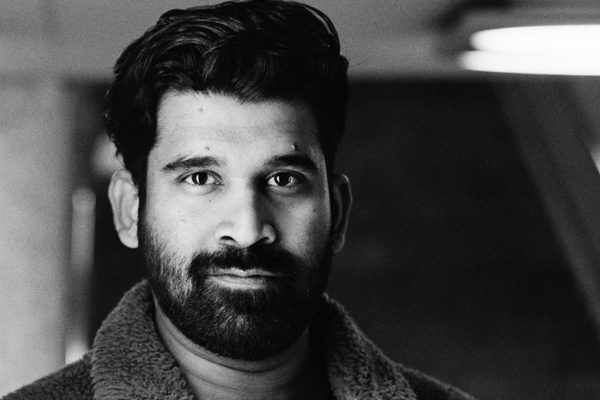
Alumni Spotlight: Darwin Prakash
News Story
In 2022, Darwin Prakash became Principal Baritone at Staatsoper Hannover in Germany, making multiple role debuts as Figaro in Il barbiere di Siviglia, Papageno in Die Zauberflöte, The Count in Le nozze di Figaro, Silvio in I Pagliacci and Chou En Lai in Nixon in China.
Darwin recently made his debut with the English National Opera as Guglielmo in Cosi fan tutte and returned to Glyndebourne as Schaunard in La bohème where he was previously part of their chorus and received the Gus Christie Award.
We spoke to Darwin about his unique journey to becoming an opera singer.
What inspired you to pursue a career in music?
Basically, I wasn’t trying to pursue a career in music at all. I was studying geology at Delhi University and was more inspired to join NASA or National Geographic for expeditions and exploration. I graduated with a geology degree, and the inspiration to pursue music really rather found me.
I was part of the choir in church and a capella groups in college, I did gigs with friends and even beatboxing, but nothing classical. Because I was open to all kinds of music I came across the Neemrana Music Foundation in Delhi, which brought in teachers from abroad to teach western classical music. One of them was Robert Alderson, who is currently a professor at Trinity Laban. I joined a workshop and he picked me out, asking why I hadn’t been there earlier. When I told him I had geology exams, he invited me for a lesson anyway. After a week of lessons, he suggested I think about pursuing classical singing, maybe giving it one year to see if I could get into a conservatoire in the UK.
It was a question of mutual trust. After hearing of Robert’s accomplishments, I trusted that I could do something with my time at a conservatoire. People around Robert and me were doubtful of this collaboration and were advising us to be cautious of such a big commitment. But my mother said ‘at least you can go and live in the UK for one year.’ I had already finished my degree and I was about to apply for a Master’s, so I just went for it. Robert helped me financially, helped with my visa, and I stayed with him in Manchester for six months while he taught me from scratch. I auditioned at the Academy and got onto the Master’s course, studying with Mark Wildman. Robert remains a longstanding mentor and an important figure in my life. Then I received the Sainsbury Scholarship to study with Royal Academy Opera for two years. That’s how everything set in place, and it has worked out pretty well for me.
I wasn’t trying to pursue a career in music at all. I graduated with a geology degree, and the inspiration to pursue music really rather found me.
What is the most challenging part of being an opera singer? And the most fulfilling?
The most challenging part is that this career can sacrifice other parts of your life. It was told to us right from the beginning and you learn to navigate it. Eventually there are calls that you need to make, because you go through a certain stage of life where you need to navigate what matters to the heart in terms of relationships, while putting it beside your passion for music and a career in this field. The most fulfilling part is the people. During the last contract that I did, I met such amazing people who were so compassionate and loving. Sometimes you come across people who are not at all on the same wavelength as you and you just do the job and get out of there. Other times, you might be working with people who are absolutely devoted to a supportive environment, with so much understanding and a great level of artistry. And then of course making my debut at English National Opera. Wow. To sing on that stage was incredible. I loved it. That auditorium is so huge you can’t even see where it ends from the stage. So singing with all those amazing artists and taking a bow on that stage was a very fulfilling moment for me.
How did your Academy training help to prepare you for your career?
Every aspect helped me; the drama lessons, movement, song classes and coaching. I remember feeling almost overwhelmed that I was there, working with so many incredible people and absorbing so much from every session. Ten years later, I find myself going back to those lessons all the time. Your body changes, your back hurts, your hamstrings tighten, you lose your voice temporarily due to sickness and suddenly you realise how valuable that early training was. I’ve worked in theatres in Germany and in the UK, but the level of understanding and continuity I had at the Academy doesn’t really match anything else – working with the same teachers over two or four years gives you something really deep. The access to the library was another huge gift. I remember being told to use all the music in front of me because once you leave, you won’t have access to it in the same way. That has stayed with me. I still revisit recordings of my lessons, and every time, something from that period helps me again. So truly, every aspect of my Academy training has continued to support me.
Your body changes, your back hurts, your hamstrings tighten, you lose your voice temporarily due to sickness and suddenly you realise how valuable that early training was. I still revisit recordings of my lessons, and every time, something from that period helps me again.
Do you have any memories that stand out from your time at the Academy?
The one that stands out is graduation. It was a really proud and happy moment for me. My parents had travelled to the UK for my graduation in 2019, and my brother, my teacher and a dear aunt were all there, along with so many loved ones. Right at the end of the ceremony, I was called up to receive the Queen’s Commendation for Excellence. It felt surreal – it was a complete surprise. I couldn’t believe it was happening because in the Academy you’re surrounded by so many incredible musicians across different disciplines; people already performing in major venues and releasing recordings. I never expected to be chosen. I was shocked, grateful and honestly a bit overwhelmed. I thought: ‘Why me?’, but I was deeply grateful. Seeing my father jumping up and punching the air, something so out of character for our very quiet, measured family, was incredibly moving.
What advice do you have for anybody who's looking to follow a similar career path to you?
I don’t think I’m ‘big enough’ to give advice, but the advice I’d give myself – and therefore anyone following a similar path – is this: if you love making music, if you love working with people and you’re ready to put in the time and effort in whatever way suits you, then you’re already on the right track. Everyone learns differently. I take a long time to practise and learn my music, but once I’ve learned it, I feel bulletproof. So if you’re willing to take in the details, practise and do the work in your own time, that’s what matters.
You also need passion – for music-making, for the art form, for opera itself. But with that passion, you also have to be prepared for the inevitable challenges, because the industry is full of rejection and it will try to beat you down. You have to be honest with yourself and ask ‘do I really want this?’ If the answer is yes, then don’t give up. There’s truth in those stories of artists working as waiters while auditioning for the biggest role of their lives.
At the Academy you reach one important checkpoint, but after that everyone’s trajectory is different. Some take longer to reach where they want to be. So the core advice is: if you have the desire and the passion for the music, keep going. Without that, things stop making sense very quickly.
At the Academy you reach one important checkpoint, but after that everyone’s trajectory is different. Some take longer to reach where they want to be. So the core advice is: if you have the desire and the passion for the music, keep going.
What's next for you in your career?
I’m continuing to audition, and I’m also looking forward to making debuts at Houston Grand Opera and at Stadttheater Klagenfurt, Austria. It’s an exciting time, and I’m preparing for the next steps in my performing career.